To hell with the facts. What does the cause demand?
Posted by Ed Folsom, July 18, 2026 (Edited 7/19/2026 to attempt to address formatting error in 17-A M.R.S. section 107).
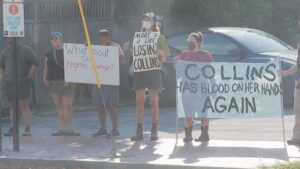
(Photo WGME)
The law and its rule (There’s no legal advice here– just legal information and observation).
On Monday, 7/13/26, an Immigration and Customs Enforcement agent, identified in news reports as David Brouillette, shot Johan Sebastián Durán Guerrero, in Biddeford. Guerrero was behind the wheel of a car at the time. When the car came to rest, there were bullet holes in the driver’s side windshield. ICE agents pulled Guerrero from the vehicle. He died at the scene.
Were Brouillette’s actions legally justified? That depends entirely on who was doing what, on where Brouillette, Guerrero and others were positioned, and on what level of threat Brouillette reasonably believed Guerrero presented to himself or others when he fired the shots.
First, it’s important to understand that it’s a crime to try to “hinder, delay or prevent” a law enforcement officer from detaining or arresting you, either by refusing to stop at the officer’s request or signal, or by using physical force against the officer or creating a substantial risk of bodily injury to the officer. Doing any of this constitutes “refusing to submit to arrest or detention.” Failing to stop upon request or signal is a Class E crime, while using physical force or creating a substantial risk of bodily injury to the officer raises it to Class D.
Also, if you think that an officer who is trying to stop or arrest you has the wrong guy or that the stop or arrest is somehow illegal, Maine statutes specifically state that you are “not justified” in using physical force against the officer, “regardless of whether the arrest or detention is legal” (See subsection 1-A of section 108, here).
These rules apply to everyone. They have been enacted by the democratically elected representatives in Maine’s Legislature and are part of the “rule of law” in Maine.
Police use of force is addressed in a Maine statute titled “Physical Force in Law Enforcement,” Title 17-A M.R.S. section 107. The relevant part provides:
2. A law enforcement officer is justified in using deadly force only when the officer reasonably believes such force is necessary:
A. For self-defense or to defend a 3rd person from what the officer reasonably believes is the imminent use of unlawful deadly force; or
B. To effect an arrest or prevent the escape from arrest of a person when the law enforcement officer reasonably believes that the person has committed a crime involving the use or threatened use of deadly force, is using a dangerous weapon in attempting to escape or otherwise indicates that the person is likely to endanger seriously human life or to inflict serious bodily injury unless apprehended without delay; and
(1) The law enforcement officer has made reasonable efforts to advise the person that the officer is a law enforcement officer attempting to effect an arrest or prevent the escape from arrest and the officer has reasonable grounds to believe that the person is aware of this advice; or
(2) The law enforcement officer reasonably believes that the person to be arrested otherwise knows that the officer is a law enforcement officer attempting to effect an arrest or prevent the escape from arrest.
There is no question that Brouillette used deadly force against Guerrero. Was the use of deadly force justified? Section 107 provides that a law enforcement officer is “justified in using deadly force only” when Section 107’s terms are met. So, to begin with, Brouillette was not justified unless he (1) believed that it was necessary to use deadly force, and (2) his belief was “reasonable.” Also, Brouillette had to have believed that deadly force was necessary for one of three particular purposes, either to: (1) defend himself from Guerrero’s imminent use of unlawful deadly force; (2) defend a third-person from the same; or (3) arrest Guerrero or prevent Guerrero’s escape from arrest.
But if Brouillette used deadly force to effect Guerrero’s arrest or to prevent Guerrero’s escape, deadly force was not justified unless other requirements were met as well. Brouillette must also have believed that Guerrero either: (1) had committed a crime involving the use or threatened use of deadly force; or (2) was using a dangerous weapon in attempting to escape; or (3) otherwise indicated that he was likely to seriously endanger human life or to inflict serious bodily injury unless he was apprehended without delay. And Brouillette must also have reasonably believed that Guerrero was aware he was a law enforcement officer attempting to arrest or prevent Guerrero from escaping arrest.
Regarding what it means to use a dangerous weapon in attempting to escape, under Maine law a dangerous weapon includes “any… device, instrument, material or substance… which, in the manner it is used or threatened to be used is capable of producing death or serious bodily injury” (See subsection 9, here). For instance, a vehicle is a dangerous weapon if a person uses it in a manner that threatens to collide with someone and cause serious bodily injury.
Nobody can possibly know whether Brouillette’s shooting of Guerrero was legally justified without knowing the particular facts that are required to address these issues.
Does it matter that Guerrero might not be the person with a final deportation order whom ICE agents initially set out to arrest on the morning of July 13?
No. As shown above, if a law enforcement officer mistakenly tries to detain or arrest the wrong person, the person is required to submit to the officer’s commands. It is a crime not to. If the officer who is attempting to effect the arrest or detention has grounds to reasonably believe it’s necessary to use deadly force to address one of the threats set forth in section 107, the officer is legally justified in using deadly force. If not, the officer is not justified. It is immaterial whether the person the officer reasonably believes presents such a threat is the same person the officer originally set out to arrest or detain. So says the law.
ICE initially indicated that its officer shot Guerrero in self-defense, then they changed that to claim that the agent shot Guerrero “fearing for public safety.” Can a fear for public safety justify such a shooting? If so, what type of threat to public safety is required?
Yes, and see above. A fear for public safety apart from the need for imminent self-defense or defense of a third-person can justify law enforcement’s use of deadly force, as discussed above, within the limits discussed above. However, just any old fear for public safety doesn’t justify the use of deadly force.
In assessing whether Brouillette’s shooting of Guerrero was justified, does it matter that Brouillette’s ex-wife initiated a protection from abuse action against him after the shooting?
No. Today’s Portland Press Herald ran a sensationalized story, top of local section, above the fold, under the headline: “Second ex-wife seeks protection order against ICE agent to who shot, killed man – The woman sought sole custody of her daughter with David Brouillette.”
The story recounts prior bad acts reported by Brouillette’s two ex-wives and hints at possible others (“Former colleagues in Manchester confirmed he was a volunteer firefighter there and left on poor terms”), risking that the public might conclude Brouillette is a man of bad character who has acted badly in the past and probably acted in accordance with his bad character here.
This type of thing is barred from use as evidence in court by Maine Rule of Evidence 404(a)(1), which provides,
“Evidence of a person’s character or character trait is not admissible to prove that on a particular occasion the person acted in accordance with the character or trait,”
and by 404(b) which provides,
“Evidence of a crime, wrong, or other act is not admissible to prove a person’s character in order to show that on a particular occasion the person acted in accordance with the character.”
It isn’t until the 22nd paragraph in the 27-paragraph Press Herald story that the reporter finally begins to address what the ex-wife’s protection from abuse complaint alleges. In paragraph 24, we are told: “The woman said in the request that she has been inundated with requests from media outlets since Monday and that she is concerned her daughter may become a target.” Then, in the next-to-the-last paragraph, the story tells us that a judge “declined to issue her a temporary protection from abuse order on Thursday after a hearing,” because the plaintiff’s allegations were “insufficient to support a finding that the plaintiff and/or minor child is or are in immediate and present danger of abuse from the defendant.” But who reads that far? You already got the dirt well before that.
A fact-free environment.
Such is the environment we are currently operating in – free of any and all pertinent facts regarding the pertinent time frame – leaving the public to indulge its preconceptions and preferred narratives, unimpeded by any facts whatsoever and whipped-up by sensationalizing media.
Has there ever been a case where an officer shot a driver who failed to submit to arrest in Maine where the officer’s use of force was determined to be justified?
Yes, at least one. On April 10, 2011, Portland Police Officer Robert Miller fired shots at a car driven by Jonathan Mitchell as Mitchell, quickly accelerated away from a traffic stop after a chase. Neither Miller nor his backup officer were in the path of the fleeing vehicle. Two bullets entered the rear driver’s side window and struck Mitchell in the neck and upper back. Police found Mitchell elsewhere in Portland about an hour-and-a-half later. He survived his wounds.
The Attorney General reviewed Miller’s use of force, as required by law, and determined that it was justified based on facts gathered during an investigation and on the controlling law. The A.G.’s determination was highly fact-specific, as it must always be. You can read the details here.
Mitchell sued Miller in federal court, alleging that Miller used excessive force against him. The District Court rejected Mitchell’s claim on summary judgment, ruling that Miller was entitled to judgment as a matter of law on the undisputed facts. On appeal, the First Circuit Court of Appeals upheld the determination, stating, “Mitchell has the burden of demonstrating that as of April 10, 2011, the time of the alleged violation, the law was clearly established such that a reasonable officer in Miller’s shoes would be on notice that his actions would violate the Fourth Amendment.” The Court concluded, “Mitchell has failed to demonstrate that it was clearly established that Miller’s conduct was constitutionally unreasonable in these circumstances.”
You can read the first circuit opinion here.
The facts don’t matter, man.
In 1991, I was an Assistant D.A. for Cumberland County, in Portland, Maine. In December of 1991, William Kennedy Smith was placed on trial for alleged rape, in Florida. Back then, the Cumberland County D.A.’s Office had daily contact with advocates for the “Family Crisis” organization. Family Crisis monitored the prosecution of domestic violence cases as advocates in what was known as the Battered Women’s Movement. They and a couple of Assistant D.A.’s who handled a lot of the Office’s domestic violence (DV) cases got very worked-up over the ongoing William Kennedy Smith trial. In fact, one of those Assistant D.A.’s told me that Kennedy Smith’s trial stood for everything, such that his acquittal would be a major setback for women.
To these advocates, William Kennedy Smith’s trial wasn’t just a criminal trial where the state presented evidence to a jury and the jury determined whether the state met its burden of proof beyond a reasonable doubt. No, William Kennedy Smith’s trial was a symbol. It was a cause. To hell with the details. What mattered was what outcome the cause required for its advancement. There’s no need to put evidence to the test of a trial to figure out what outcome the cause demands.
In the aftermath of Guerrero’s shooting, for way too many people, it’s pretty much the same deal.
To hell with the facts. Everything they need to know is in the answer to the question: What does the cause demand?
